
The Evolution of the Animation Pipeline: From Hand-Painted Cells to AI-Generated Worlds


Animation has always been a marriage of artistry and engineering. Since the first hand-drawn frames of the early 20th century, the "pipeline" - the sequential journey from a blank page to a moving image - has been the heartbeat of the industry.
Understanding these shifts is about more than appreciating history. It is about recognizing a fundamental shift in human productivity: we are moving from a world of manual execution to a world of creative intent.
1. The Era of Physical Labor: Traditional Cel Animation
In the golden age of animation, the pipeline was a monumental feat of manual synchronization and industrial-scale labor.
- The Process: Every single second of film required 24 individual drawings. These were first sketched on paper, then meticulously inked and painted onto transparent acetate sheets called cels. These cels were layered over static backgrounds and photographed frame-by-frame.
Can you believe that it took 15 months (not kidding) to create this 4 seconds of crowd scene?
- The Bottleneck: This was a linear, high-stakes pipeline. If a director wanted to change a character’s movement after the cels were painted, it meant discarding hundreds of hours of manual labor - there was no undo button. The example above illustrates this well: creating just 4 seconds of a crowd scene took roughly 15 months. As seen in the video footage, the scene is composed of hundreds of distinct characters, each moving independently and interacting with the environment. Even if animating a single character took only half a day to a full day, a traditional cel-animation pipeline could easily require more than a year to produce a scene of this complexity.
- The Legacy: This era proved that life in characters comes from a deep understanding of physics and emotion - rules that remain the gold standard even today. Personally, I still love watching cel animation. It carries a distinctive tactile quality and a sense of nostalgia that is very hard to replicate in computer graphics. While the vast majority of the industry has moved on to fully computer-generated or hybrid pipelines, I believe a small -though likely niche- segment of traditional cel animation will continue to exist for some time.
2. The Digital Architecture: The 3D & CG Revolution
When the movie Toy Story debuted in 1995, it re-engineered the pipeline into a virtual construction site. This shift moved the industry from drawing to simulation.
- The Process: Instead of drawing frames, artists became digital sculptors and puppeteers. They built 3D models, which were then rigged with complex digital skeletons. Animators would set keyframes (the start and end points of a movement), and the computer would calculate the movement in between - a process known as interpolation.
- The Paradigm Shift: With the adoption of 3D tech, animation was no longer a one-way sequence of irreversible steps. Once characters and environments existed as digital assets - defined by geometry, rigs, materials, and shaders - each stage became loosely coupled rather than permanently baked in. Animation data could be reused while lighting setups, camera lenses, focal lengths, render passes, and textures were adjusted independently. A director could change a camera from a wide lens to a telephoto shot after animation was finished, relight a scene from daytime to dusk, or swap materials without touching the underlying motion. Because those representations were explicit and modular, iteration became computational rather than manual. The cost of change shifted from human labor to compute time - render hours instead of redraws - fundamentally redefining how late-stage creative decisions could be made in animation.
- The Hidden Cost - The Learning Curve: This flexibility came at a steep cost. Mastering 3D requires years of technical training. If cel animators were closer to fine artists, 3D artists became technical artists by necessity. In practice, nurturing a fully capable 3D artist requires at least as much time, and often more, than training a traditional cel animator. On top of that, they had to think simultaneously like sculptors, engineers, cinematographers, and physicists. As a result, the pipeline fragmented into highly specialized roles - modelers, riggers, animators, lighting artists, and technical directors - making production dependent on large, tightly coordinated teams. 3D is undeniably powerful and has reshaped animation production. But it is also hard to learn and fragile, which is why 3D artists don’t sleep easily.
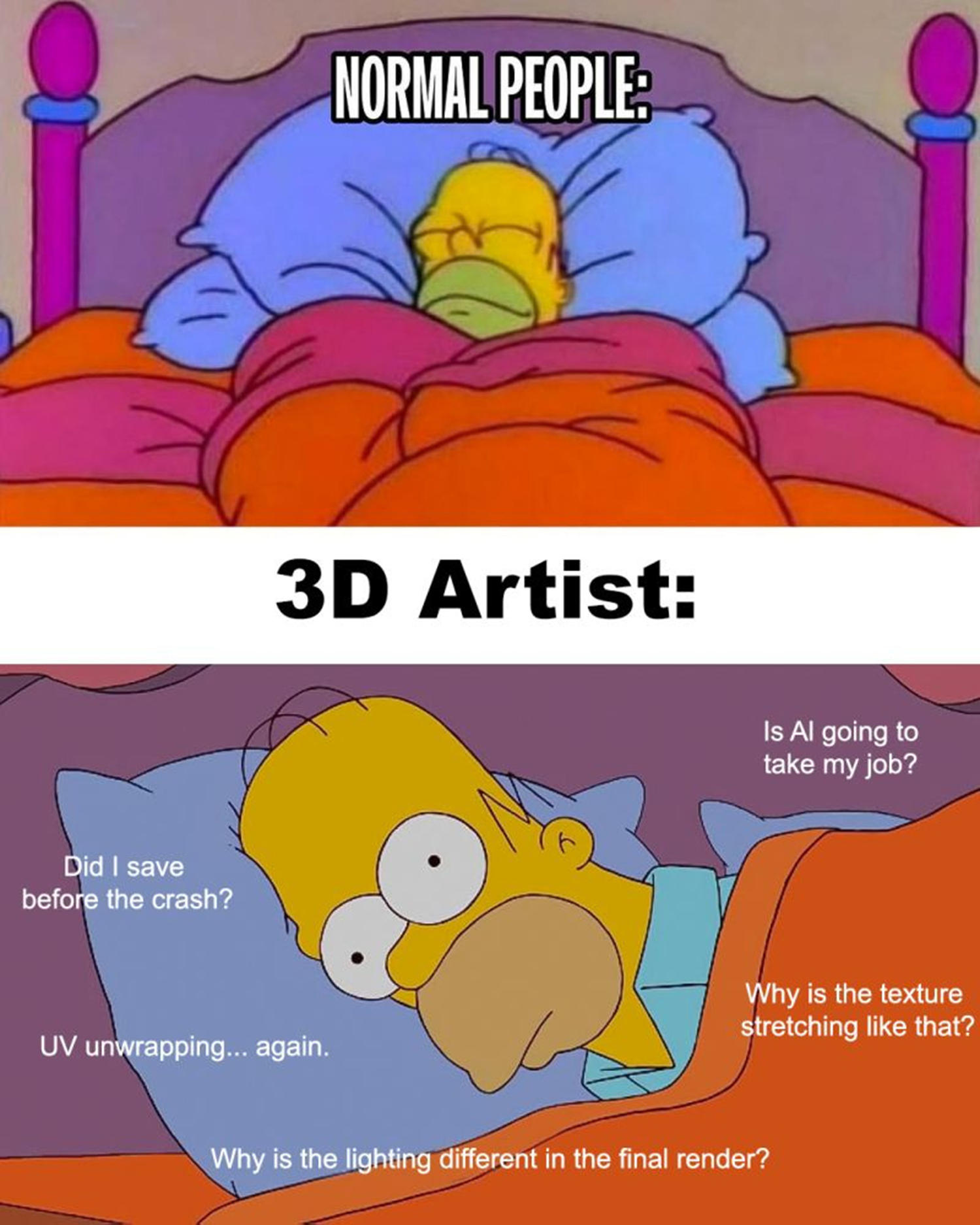
3. The Generative Frontier: AI as the New Engine
We are now entering the third great epoch. Generative AI (GenAI) is transforming the pipeline from manual manipulation to intent-based creation.
- 3D GenAI: Traditionally, modeling a complex environment took weeks. Today, image-to-3D and text-to-3D tools such as Claythis allow creators to generate rigged assets in minutes, democratizing high-fidelity production for smaller teams. There are a few more startups offering 3D GenAI pipelines, but Claythis is the only one where you can generate fully rigged and animated 3D characters with single click. The results from 3D GenAI tools are still technical - often, FBX, GLB, etc. To get the final animation output, you will need expertise and knowledge in 3D. However, this remains the most effective way to accelerate production if you care about maintaining control over the final animation output - by combining AI systems with 3D artists in what is commonly referred to as an AI-human hybrid pipeline.
- Video GenAI: It is not just an advanced version of 3D GenAI, but a collapse of the animation pipeline itself. Instead of explicitly constructing scenes through modeling, rigging, keyframing, lighting, and simulation, these systems generate finished animation by autoregressively predicting future frames (or latent representations) conditioned on inputs such as text and images. The output is immediately usable video - often an mp4 - delivering final animation without intermediate assets. Until early 2025, the absence of explicit representations made character consistency unreliable. However, the recent models such as Nano Banana / VEO 3.1 have made significant improvements in consistency management. Just a few days ago, Google announced its AI Film Award winner; Lily. Can you spot inconsistencies in the characters or props? Perhaps - but they are increasingly subtle, and in many cases, barely noticeable.
Just amazing.
- The Impact: The barrier has collapsed: Creating animation has become shockingly easy, even without the help of professional artists. While knowledge of rigging, lighting, camera movement, or shot composition is still valuable, creators no longer need to fully understand - or manually operate - any of it. Video GenAI models can already produce good-enough results by implicitly handling these technical layers under the hood. What once required a coordinated team of specialists can now be achieved by a single creator iterating through natural language and visual prompts. In this world, the feedback loop is not just faster - it is almost invisible. And as these models continue to improve, it raises a provocative question: if high-quality motion, lighting, and cinematography can be generated directly at the pixel level, do we still need explicit 3D generation at all?
The Executive Summary: Humans Still at the Center
The evolution of the animation pipeline reveals a consistent direction: not the removal of humans, but the removal of technical friction between human intent and visual output.
- Traditional animation demanded deep craftsmanship, with iteration constrained by physical labor.
- 3D/CG pipelines expanded creative freedom by turning many irreversible steps into adjustable parameters.
- GenAI models compress technical execution even further, allowing creators to explore ideas at the speed of thought.
What changes across these eras is not the importance of human input, but where human effort is spent. As cels gave way to pixels, and pixels to prompts, the role of the creator shifts from executing technique to expressing intention, exercising taste, and providing continuous feedback. Direction, judgment, and creative sense do not disappear - they become the primary bottleneck.